After WRC 2026: how to evaluate an embodied-robot pilot
A demonstration shows that a robot completed a motion in one prepared setting. It does not establish performance across workpieces, poses, human intervention or recovery. A useful pilot fixes the task, varies one condition at a time, and records outcomes rather than highlights.
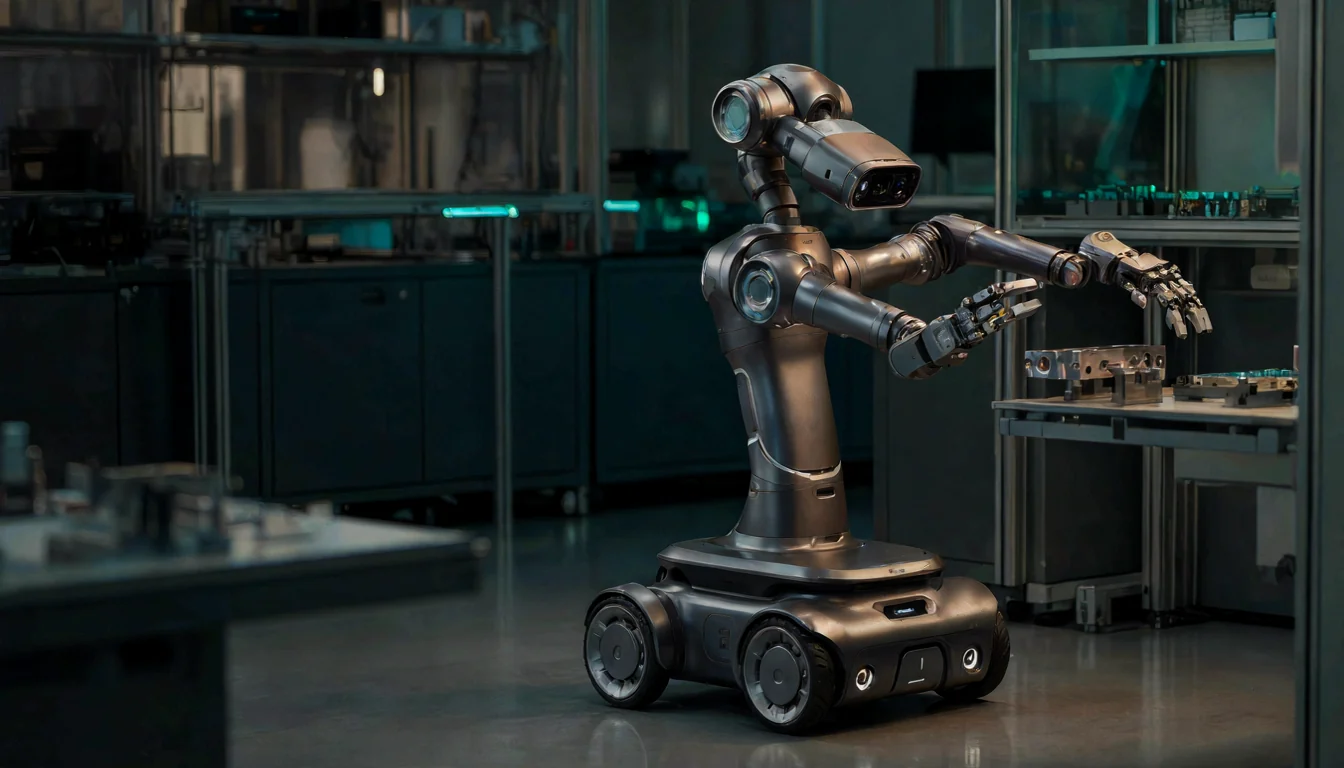
The short answer: after an embodied-robot demonstration, write a repeatable pilot protocol before discussing deployment. Fix the workpiece, station, operator roles and definition of success. Add representative variation in controlled stages, then record completion, task time, intervention, failure class and recovery. A clean demonstration supports further investigation; it is not site-acceptance evidence.
What WRC 2026 signals—and what it does not
The official closing report, published on 24 August, says the five-day 2026 World Robot Conference ended on 23 August under the theme of human-machine coexistence and closer connection between production and demand. The event included seven main forums, 71 concurrent activities and more than 3,000 products from 373 exhibitors. Its official programme gave dedicated space to scenario deployment, technical maturity, data for physical intelligence and commercial implementation.
That programme is evidence of where the industry conversation is moving: from isolated motions toward applications, data and operating systems. Event scale and a successful stage routine, however, do not establish fitness for a particular plant. Buyers still need to translate what they saw into measurable requirements for their own task.
| Demonstration evidence | Reasonable conclusion | Evidence still needed for a pilot |
|---|---|---|
| One complete pick, assembly or mobile-manipulation cycle | The system completed that task in the prepared setup | Repeated trials and distributions across workpiece pose, batch, location and background |
| Tasking through natural language | Some instructions can be converted into an action sequence | Ambiguity, missing information, prohibited requests, confirmation points and operator authority |
| A continuous bimanual or mobile sequence | Subsystems coordinated along one demonstrated path | Docking error, shared-object constraints, occlusion, mutual collision and interrupted-task recovery |
| A claim of operation across many scenarios | The supplier has a generalization objective | Training and configuration boundary, unseen objects, site variation and re-teaching effort |
| Component specifications or standard test results | A named component has defined performance under stated conditions | Integrated perception, manipulation, cycle, fault and safety evidence for the actual task |
Start with task decomposition, not a universal score
A NIST review of robot evaluation and benchmarking explains that capabilities such as grasping, assembly and obstacle avoidance need common measures interpreted in the relevant application context. NIST's performance-assessment framework decomposes assembly into perception, mobility, dexterity and safety measures, then considers how component results contribute to system performance.
“Success rate” is therefore incomplete without a denominator and a test distribution. A task can be split into detecting the target, estimating pose, reaching, grasping, manipulating, verifying the outcome and recovering. Whether a failure began with perception, reachability, grasp stability, planning, control or a correct business-rule refusal determines whether the next change belongs in data, tooling, sensors, planning or task design.
A six-stage protocol for a comparable site pilot
- Freeze the task and business outcome. Define incoming material, start and end states, permitted actions, quality criteria, people, target cycle and unacceptable outcomes.
- Build a representative baseline set. Retain normal parts, boundary examples and reachable real faults. Record pose, surface, lighting, station and tool state.
- Add variation deliberately. Prove the fixed condition first, then vary object, position, background, instruction and equipment state separately so failures remain diagnosable.
- Record every attempt. Capture success, partial success, failure, correct refusal, intervention, time, failure stage, recovery action and final business result. Keep failed samples.
- Exercise interruption and recovery. Include lost targets, failed grasps, blocked paths, communication loss, changed workpieces and human entry, with the expected safe state and restart path.
- Make a gated decision. Derive thresholds from the business and risk, not the best exhibition run. State what allows expansion, what requires redesign and what stops the pilot.
Component performance, system capability and safety are separate evidence chains
ISO 9283 defines performance criteria and related test methods for manipulating industrial robots; ISO states that the 1998 edition was reviewed and confirmed in 2021 and remains current. It can inform evidence for mechanical pose and path performance, but it does not by itself establish perception, generalization, tooling, process quality or end-to-end application performance.
A performance pilot also does not replace safety acceptance. Integration, commissioning, operation and maintenance of the complete robot application belong to a different responsibility and evidence boundary; our ISO 10218:2025 application guide outlines that distinction. If a protective stop occurs during a performance trial, record its cause and verify intended behavior rather than automatically scoring it as an algorithm defect.
Matrix Dimension perspective
The following is an engineering inference from the conference material and NIST evaluation work: the most useful first deliverable for an embodied-robot project is not a smoother video, but a task protocol the buyer, integrator and developer can all rerun. Teams considering an AI single/dual-arm control hub or a wheeled humanoid platform can begin with one bounded task and observable business result, establish a fixed baseline and perturbation matrix, then decide whether to broaden scope. See also our guide to separating AI planning from real-time control.
Scope boundary: This article uses official conference information to identify an industry direction and public evaluation work to propose a pilot method. It does not assess any WRC exhibit or claim unpublished Matrix Dimension success rates, cycle times, accuracy, certification or production readiness. Named hardware, tasks and site conditions must determine project metrics.
Frequently asked questions
Are several successful exhibition runs enough to begin procurement?
They can justify technical due diligence or a controlled pilot, but not site acceptance. Before procurement, align the task, samples, variation, scoring and recovery requirements, then examine the full outcome distribution rather than selected successes.
Should an embodied-robot pilot use only end-to-end success rate?
Keep the end-to-end result, but also record where failures begin, intervention, task time, recovery and business impact. Without stage evidence, the team cannot tell whether to change perception, planning, tooling, control or the task itself.
Does robot repeatability establish bimanual assembly performance?
No. Mechanical performance is an important input, while bimanual assembly also depends on frame relationships, tooling, workpiece constraints, perception, coordination, contact and the process-quality decision. Validate the complete task.
Sources
These primary sources support the material facts and engineering boundaries discussed above.
- 2026 World Robot Conference — official closing report, 24 August 2026
- 2026 World Robot Conference — official concurrent-event programme
- NIST — Advancing Capabilities of Industrial Robots Through Evaluation, Benchmarking, and Characterization
- NIST — Performance Assessment Framework for Robotic Systems
- ISO 9283:1998 — Manipulating industrial robots — Performance criteria and related test methods
- ISO 10218-2:2025 — Safety requirements for industrial robot applications and robot cells
Evaluating robot control, bimanual manipulation or a mobile platform?
Talk to Matrix Dimension →