ISO 10218:2025: why robot compliance is not application acceptance
Evidence for the industrial robot is only one input to safety acceptance. The end effector, workpiece, task program, connected machinery and people together create the application that must be assessed and validated.
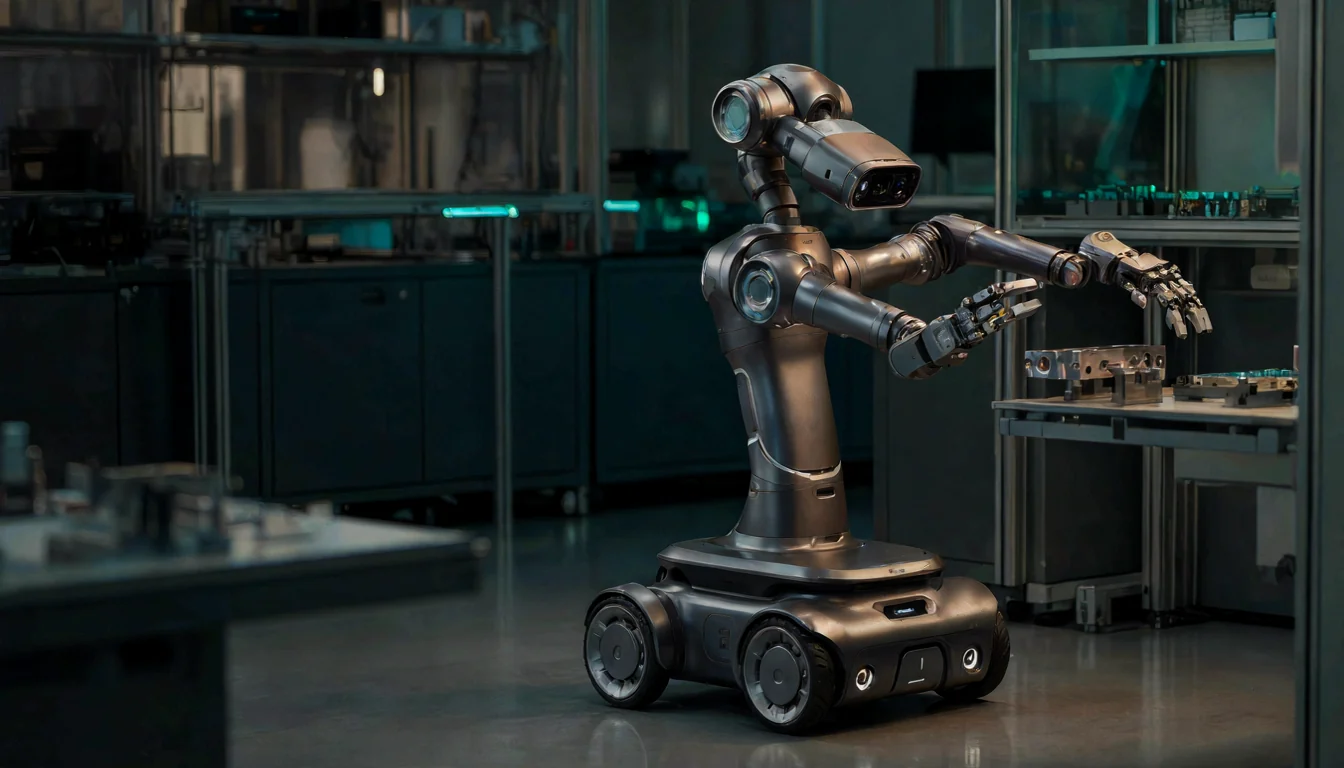
The short answer: an industrial robot supported by ISO 10218-1:2025 evidence is not a pre-approved cell. Once an integrator adds tooling, workpieces, task code, sensors, conveyors or a mobile base, the risk picture changes. Acceptance must address the complete application under ISO 10218-2:2025 and any other requirements that apply to the process or machine.
Two parts, two different objects of evidence
ISO 10218-1:2025 addresses the industrial robot as partly completed machinery. Its public scope notes that application hazards, such as those introduced by a process, are handled during application design. ISO 10218-2:2025 moves outward to the industrial robot application and cell, including integration, commissioning, operation, maintenance and decommissioning. Manufacturer documentation is therefore an essential input to the integrator, not the final conclusion for the deployed workstation.
| Acceptance layer | What is in scope | Evidence to request |
|---|---|---|
| Industrial robot | Manipulator, controller, manufacturer-provided safety functions and operating limits | Applicable declarations, instructions, safety-function data, limits and interface information |
| Robot application | Robot, tool, workpiece, programs, auxiliary machinery, people and workspace | Task-based risk assessment, risk-reduction design, validation plan and results, residual-risk information |
| Human access or contact | Shared space, access routes, speed and separation, crushing and impact scenarios | Representative access tests; for contact, recorded pose, load, speed, measurement locations and results |
| Mobile manipulation | Navigation, braking and operating zone plus arm motion while travelling, docking or working | Requirements mapped to both subsystems, followed by tests of their interaction and failure states |
| Process | Sharp tooling, hot work, machining, chemicals, heavy loads and stored energy | Applicable process requirements, isolation, maintenance and emergency measures |
A “cobot” label is not an application decision
Risk follows the task, not the product nickname. A robot presenting a lightweight part at low speed and the same robot carrying a sharp tool create different exposure and injury mechanisms. Human access, foreseeable contact, the workpiece, end effector and operating modes all influence the safeguards and validation needed. This application focus is why buyers should ask what was assessed, not merely whether the robot is marketed for collaboration.
Where physical contact is part of the design, a configured speed or force limit is not sufficient evidence on its own. ISO/PAS 5672:2023 specifies methods to measure and analyse force and pressure in human-robot contacts. Its scope also makes clear that those measurements do not identify every contact hazard and do not cover hazards such as falls, electricity or chemicals. Measurement supports validation; it does not replace risk assessment.
A six-stage path from concept to site acceptance
- Freeze the intended use. Name the people, workpiece, tool, payload, speeds, automatic and manual modes, changeover, jam clearing and maintenance tasks. Include foreseeable abnormal work, not only the production cycle.
- Build an applicability map. Separate the robot, completed application, connected machinery, process and mobile platform. Record exclusions instead of stretching one declaration across the system.
- Assess risk by task. Use the principles in ISO 12100 to identify hazards across the lifecycle, estimate and evaluate risk, select risk-reduction measures and document verification.
- Turn safety functions into testable requirements. For guards, emergency stops, protective stops, mode selection, enabling devices and speed or separation monitoring, define the trigger, safe state, reset conditions and required performance.
- Exercise faults and maintenance. Test obscured sensors, dropped workpieces, interrupted programs, communication faults, human entry, energy isolation, manual recovery and return to service after maintenance.
- Deliver traceable records. The acceptance pack should connect each hazard to its measure, validation case, result, residual risk, training and change owner. Reassess the affected scope when software, tooling or tasks change.
Why a mobile manipulator needs another boundary check
The published scopes of ISO 10218-1 and ISO 10218-2 exclude the mobility of a manipulator integrated with a mobile platform. Where a base is classified as a driverless industrial truck, ISO 3691-4:2023 addresses the truck and its system and notes that operating-zone conditions materially affect safe operation. The applicable route depends on the actual machine and market, but the engineering implication is clear: navigation, braking, person detection and docking must be assessed together with arm motion and tooling. Compliance evidence from either subsystem cannot establish the safety of the combined task.
Matrix Dimension perspective
The following is an engineering inference from the public scopes: the most productive starting point is not “Do we need a cobot?” It is one representative task with named people, material, tooling and recovery paths. Teams evaluating a single- or dual-arm control hub or a wheeled humanoid system can first build a three-column hazard–measure–validation record, then expand the task set. Our related guide explains why AI planning and deterministic execution need separate control layers.
Scope: This guide interprets public ISO scope pages for engineering procurement and acceptance. It is not certification or regulatory advice, and it does not claim certification of Matrix Dimension products. A competent responsible party must determine the requirements from the machine classification, application, jurisdiction and complete standards.
Frequently asked questions
Does an ISO 10218-1 compliant robot make the completed cell safe?
No single robot-level claim can establish that. Tooling, workpieces, programs, connected equipment, human tasks and the workspace introduce application hazards that require risk assessment, risk reduction and validation.
Can a collaborative robot be installed without guarding?
The product label does not decide the safeguard. The task risk assessment, access pattern, tool and workpiece hazards, selected collaborative method and validation results determine the protective measures.
Is ISO 10218 alone enough for a wheeled manipulator?
Do not extend the arm standard to mobility without checking scope. Confirm the base and complete-machine classification and applicable requirements, then validate travel, docking, human access and arm motion as one task.
Sources
These primary sources support the material facts and engineering boundaries discussed above.
- ISO 10218-1:2025 — Safety requirements for industrial robots
- ISO 10218-2:2025 — Safety requirements for industrial robot applications and robot cells
- ISO 12100:2010 — Machinery risk assessment and risk reduction
- ISO/PAS 5672:2023 — Measuring forces and pressures in human-robot contacts
- ISO 3691-4:2023 — Driverless industrial trucks and their systems
Evaluating robot control, bimanual manipulation or a mobile platform?
Talk to Matrix Dimension →